
Um, blessed.

On December 1, I received a call from an orthopedic spinal surgeon who had once been a yoga student of mine back when I still taught yoga full-time and traveled to people’s homes for private classes. In the years prior to this call, she knew me not as her patient but as her teacher, and I knew her not as my doctor but as my student.
It was the Monday after Thanksgiving break, around eight thirty in the morning. I was pulling chairs down from tables and saying good morning to my fifth graders as they milled in, eager to tell me about the books they had just finished, the trips they had taken, the candy and desserts consumed over their holiday weekend.
I heard my phone ring.
Mornings at the school where I teach are more flexible than at traditional schools. Between 8:00 and 8:50 is transition time. The kids don’t have to sit silently at desks while I take attendance. They can play cards on the carpet near the bulletin board, which is exactly what they were doing when I went to answer the call.
Before Thanksgiving break, I had an MRI. For well over a year, I had this strange pain in my leg. Specifically, the right side of my lower leg, not my shin or calf, but somewhere in between. It wasn’t the kind of pain that affected my mobility or prevented me from living my life. I showed up to work every day. I exercised. I traveled, cooked, and kept plans with friends. But the pain persisted.
Given my years devoted to yoga and movement of some kind, I obsessed over solving it, or at least understanding its source. I sought healers and physical therapists. Acupuncture and ice packs. Epsom salts. Infrared saunas. Anti-inflammatories and affirmations. But the pain remained. Not always, but often enough.
I called it a migraine in my leg. A systemic ache. A distracting pain.
I could be out to dinner, sipping my favorite cocktail, side-saddled next to my boyfriend, and the pain would quietly announce itself. I would rub my legs together under the table like a cricket, trying to roll out the tension. I started to wonder if I would ever sleep again. Like a toxic relationship, the pain was something I had come to normalize. I just dealt with it, perhaps to some degree in denial about how much it affected my life.
Her phone number was still in my contacts. Even as I texted her, describing the pain, I worried I was overstepping boundaries. This was her personal cell phone, not her office line. I hadn’t been her yoga teacher since Covid, when I came to her home every week to teach her and her husband on their deck, with their young children tapping on the windows, asking for more juice.
I hit send.
As I grabbed my coat for work, she texted back. She offered to meet me at her office the next day. There were X-rays, PT prescriptions, and stronger anti-inflammatories. When those failed to mitigate the pain, she ordered an MRI.
“You are too young to live with it,” she told me.
It was a few days before Thanksgiving when I lay on a flat metal bed with a pillow under my legs. The technician gave me headphones, and I listened to Fleetwood Mac, unsuccessfully drowning out the intermittent honking and buzzy noise of the massive machine. I even slept for most of the thirty-minute procedure. It was the first time I wondered if my pain was a symptom of something more serious.
It was hard not to think like this. Going for diagnostics seemed to always provoke my lifelong intermittent bout with hypochondria.
Some of my students were still playing cards on the carpet a few feet away from my desk. Others were at tables reading or coloring. I signaled to a colleague to come in and keep an eye on things while I took the call. She said she would review the results of my MRI and call me as soon as she got to her office.
I was unconcerned. Just determined to find a better course of action, a more effective remedy. I was ready to break up with this pain.
I found a private space to take the call. I closed the door.
“Hi,” I said, calling her by her first name.
Her first words were, “I am sorry.” Her voice was calm, but urgent.
“I should have been alerted over break.”
I didn’t understand why she used the word alerted. Apparently, there was a red flag on my results. A red flag meant she should have been called, even while she was on vacation with her family over Thanksgiving. She was explaining this to me, and I still hadn’t quite caught on.
Then she asked, “Did you see the MRI?”
I had clicked the link and read through most of it, but I hadn’t understood it. I clearly missed the red flag. There were listed: slight disc bulging and typical degenerative lower vertebral findings. Nothing shocking. The kind of things any active fifty-five-year-old might see on an MRI.
“They found a mass,” she said. “At the base of your thoracic spine.” She continued, explaining that she had ordered another MRI immediately, this one of my upper back, with contrast.
I sat down on the small couch where the middle schoolers usually sit when they need help from the school counselor. I was in her office. The lights were off. My heartbeat was everywhere.
“What do you mean, a mass?”
“I’m sorry,” she said again.
For a brief moment, I thought about how hard this must have been for her to deliver to someone she knew beyond an exam room, beyond a lab coat and an exam table. How personal it must have felt to tell me she wasn’t sure whether the mass on my MRI was malignant.
“What do you mean, a mass?” My voice no longer sounded like that of a wise, capable, fifty-five-year-old woman. It sounded more like an eleven-year-old girl. I asked if she thought it was malignant.
The pause was unbearable.
“I don’t know,” she said.
I returned to my classroom. By then, my students had already been dismissed for their morning classes. I wasn’t doing the ordinary things I would normally be doing at 9:00 a.m.,making copies, reviewing plans, and commenting on assignments. I was pacing and crying, trying to decide who to call first: my boyfriend or my mother.
I was caught between the possibilities of a future that suddenly split between a benign cyst or a malignant tumor.
What happens in a body when your worst nightmare begins to feel real?
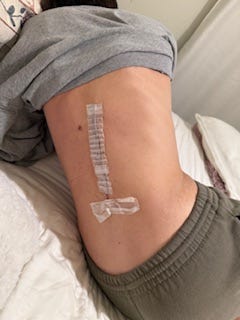
Further tests showed an impressive mass, about the size of a walnut, pressing on the central nerves of my spinal column. The certainty was that this was the source of my pain and that it needed to come out.
She was my lifeline now. The holder of all information. My former yoga student, who, with the kindness of a close friend, told me my case was beyond her scope. She was referring me to specialists with titles like neurosurgeon and neuro-oncologist. She said I would need a team.
I was at my boyfriend’s house, on his bed. I saw him through the window, walking up the stairs. I texted him: not good. When he came in, I made him listen. I couldn’t track her words. I needed him to hold them so my mind wouldn’t hijack me into believing the only possible outcome was a terminal diagnosis.
I have always been afraid of getting sick. As a child at camp, I remember overhearing stories of my bunkmate crying over her grandfather’s diabetes. I wrote panicked letters home, swearing that the ache in my foot or any suspicious lump on my skin meant certain death.
As an adult, I once taught yoga to a Yale professor who was diagnosed with esophageal cancer. I watched her transform from a radiant, healthy-boned, middle-aged woman into a walking corpse who still insisted on doing yoga, even when she could barely hold herself upright. At her funeral, I learned she died in her husband’s arms on the way to hospice. He told me that just before she died, she sat up and said it was the most beautiful thing she had ever seen. I never knew what “it” meant. I wondered what she saw, felt, in those moments she knew she was dying.
When my boyfriend said that whatever this was, we would face it, we would fight it, I wanted to knock his words to the floor like a baby rejecting unwanted food. I did not want to fight whatever it was. That isn’t to say I wanted to give up. I just couldn’t, wouldn’t, and didn’t want to accept that this orb behind my heart, pressing on my nerves like a pinball machine, could define the next chapter of my life as someone who was going to be really sick.
I was admitted to the hospital on December 3rd. My room had a partial view of Lake Michigan, a private bathroom, and a narrow upholstered banquette under a huge window. It never escaped me that the job I had needed four years earlier, after my divorce, a job that brought me back into the classroom, a job I once referred to as divine intervention when I needed stability more than anything, was the same job that now gave me extraordinary health insurance.
In the moments before surgery, my boyfriend later said my eyes never took on the eyes of a scared little girl, a look he and I knew well when we first met, when I was still stitching my life together after a transformative heartbreak. A look, he said, no longer belonged to the woman he had come to know.
As they wheeled me down the hallway, past elevators and into the pre-op wing, I felt oddly calm. If my breath could have been voiced, it might have said, What will be will be.
A team gathered around me, introducing themselves, checking vitals, adjusting IVs. There was movement and noise, but it was orderly, practiced. A nurse leaned over me and introduced herself. “Hello, Tracy,” she said with the gentlest of smiles. “My name is Aum Blessed,” I asked her to repeat it, half certain I had misheard. I saw her name tag pinned to her white lab coat. Aum, Blessed was there in embossed black letters. Something in me registered this as a sign. That was the last thing I remember before the surgery. Four hours later, Aum Blessed was leaning over me again, calling my name, waking me into the world again.
As I write this, not quite three weeks post-op, I am home. I am healing. The pain that once threaded itself through my days is gone. The pathology confirmed the mass was completely benign.
What remains is something I was aware of almost the entire time I was in the hospital, an undeniable feeling that lived alongside the pain I tried to click away with a morphine pump in those early hours after surgery, when I had no language for this new pain. A pain that was as intense as it was temporary. The old pain, gone.
Even with the shock and the speed with which everything unfolded, from diagnosis to surgery, I was never so overwhelmed or caught in the flurry that I couldn’t see something bigger holding me. The signs were everywhere.
The nurses, angels in human form. How they showed up around the clock, reminding me to inhale and exhale when I could barely inch myself from the bed to my feet. How women no older than my sons’ ages held my arm so I could hoist myself up and shuffle to the bathroom. They noticed my shoulders lifting up to my neck, guarding my every step, and gently told me that my relationship with pain was mine to understand. There was no perfect instruction to make it less. No single answer to respond to that which I had never felt before.
And how I would look at the bouquet of incredible flowers on the windowsill and think, If my mother were here, she would have already changed the water. Instead, my mother and I learned something quieter and harder together. We learned to accept that what was best for her was to stay where she was, to set boundaries around what her elder body could physically endure. And what was best for me was to see that I could mother myself through the moments I couldn’t sleep or move, and that someone would eventually notice that the water in those vases needed changing.
And it would be okay.
How my students, those fifth- and sixth-graders, sent a huge box wrapped in red ribbon. Inside was a flurry of handmade cards they had spent time creating, each one filled with primary colors and big bubble letters in marker and crayon, rainbows and cutouts, telling me to hurry up and come back! How ELA was not the same. And how their parents wrapped pajamas and lip gloss, and gift cards for meals delivered for the weeks I would be home.
My long-time yoga students, the clients who are dear friends now, who visited, who called, and rooted for me from the sidelines.
My brother brought coffee every morning when the nurses were too busy to grab one from the Starbucks kiosk downstairs in the hospital lobby. He knew to bring me extra cream. My cousins, who flew in to be there when I woke from surgery. My son, who told me every day on the phone that I was the strongest woman he had ever known, and who, as a full-time personal trainer, showed his gifts by knowing exactly what to say to help a person find their power when it felt hard to reach.
And my boyfriend, the man I may have prayed for four years ago in my car before our first date after my divorce, when I had no faith I would ever find love again. Please send me someone cool. And the universe sent me someone who would value me, and give me the space I didn’t even know I needed to grow into a woman who could face the scariest thing in her life and do it with grace.
How I learned how to feel safe in my own company. How to summon a patience I didn’t know I possessed. How to calm all the way down in some of the most uncomfortable moments of my life.
Daily, my nurses and doctors asked me, on a scale of 1 to 10, how I would rate my pain, and I would laugh and say, “You mean on a scale of a million to a billion?” And yet, through the ache and spasm of my healing body, through nerves repairing themselves from the inside out, through chemistry recalibrating moment by moment, I finally understood my life has always been training me to hold pain and grace, terror and faith, love and loss in the same breath.
And the greatest teacher, one I probably tried to duck as a child, and as an adult tried to dull, deny, or turn my back on, was pain. A tender but insistent teacher, always leading me toward what I spent years resisting, justifying, or pretending I could outrun. Pain taught me, in its own relentless way, the very things I had been most afraid to feel: the act of facing what I believed I could not face on my own.
And yet, by facing it, by feeling it, watching it morph and change, noticing what it asked of me, I began to grow qualities I did not know I possessed. Strength. Solidity. Patience. Acceptance. A deeper trust in myself. Pain, like the human angels who have continued to show up in my life, revealed my capacity back to me again and again. It taught me not to shun or curse or wish it away, but to meet it, to survive it, and to be shaped by it, and to remind me when I forget for any reason that, without question, I am enormously blessed.
Beautifully written my friend. You are an angel healing and are so blessed, i love your story it’s exceptional
Beautiful as always. And I am so grateful you are well.